Commercial flooring fails early more often because of bad subfloor prep than “bad materials.” If the slab or wood subfloor isn’t flat, clean, dry enough, and structurally sound, you’ll see telegraphing, loose spots, cracked grout, adhesive issues, and premature wear—especially with LVT and large-format tile.
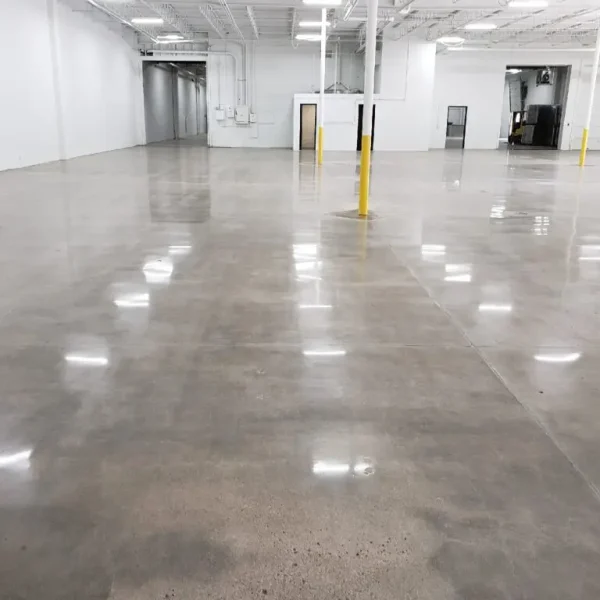
When this matters most…
- When you’re switching from carpet to LVT (you’ll suddenly “see” every defect)
- When the building is older and the slab has multiple patches or unknown moisture history
- When downtime is tight and you can’t afford rework
- When you’re installing rigid products (LVT, tile) over imperfect floors
- When you need comparable quotes and don’t want “prep surprise” change orders
What “flat” really means (industry tolerances)
Practical guidance
“Flat” doesn’t mean “level.” Level means the floor is horizontal. Flat means the floor is smooth enough that your finished flooring can lay down without rocking, gaps, or stress points.
In commercial work, flatness is about avoiding:
- Lippage (tile edges you can feel)
- Telegraphing (bumps, trowel ridges, joints showing through resilient flooring)
- Hollow/loose spots (poor adhesive contact from high/low areas)
- Premature cracking (tile/grout stressed by uneven support)
What you should expect:
- Resilient flooring (LVT/LVP, sheet, rubber): typically requires a tighter flatness than most people assume, because it will show imperfections in the finished surface.
- Tile/porcelain: can tolerate minor substrate variation in small-format installs, but large-format tile quickly exposes flatness problems through lippage.
A good installer checks flatness with long straightedges, marks highs/lows, then decides whether spot patching is enough or the job needs a broader leveling approach.
Common pitfalls
- Assuming “new slab” means “ready for flooring.” Fresh concrete can still have waves, ridges, and curing compounds.
- Assuming carpet covered sins = those sins don’t exist. Carpet hides a lot. LVT does not.
- Skipping a defined flatness target in the scope. If it’s not specified, it’s easy for prep to get minimized until problems appear.
What to specify in a quote / scope
- A flatness target appropriate for the finish material (especially for LVT and large-format tile)
- Who is responsible for measuring and documenting flatness and where (entire area vs representative sampling)
- Whether prep is spot patching only or includes full skim/leveling where needed
- A clear allowance or unit pricing for additional prep found after demo (common in older buildings)
Concrete vs plywood subfloors
Practical guidance
Concrete and plywood behave differently, and the prep approach should match the substrate—not just the floor covering.
Concrete slabs
- Strong and stable when properly built, but often have:
- cracks, control joints, saw cuts
- old adhesive residue
- surface contamination (paint, sealers, curing compounds)
- moisture vapor moving through the slab (especially older slabs without a vapor retarder)
Key goals on concrete:
- Clean, sound surface (nothing that blocks bond)
- Flat enough for the finish floor
- Moisture and alkalinity managed to the product system being installed
Plywood/wood subfloors
- Can be great under carpet tile or certain LVT systems, but you must account for:
- deflection (bounce)
- seams, fastener pops, squeaks
- moisture movement from humidity swings
- uneven transitions between panels or areas
Key goals on wood:
- Structurally stiff and well-fastened
- Seams and fasteners treated so they don’t telegraph
- Proper underlayment strategy when required (not all plywood is created equal)
Common pitfalls
- Treating plywood like concrete (or vice versa). A patching product that performs on concrete may not behave the same on wood.
- Ignoring movement. Wood moves with seasons and building conditions; ignoring that can crack grout or open seams.
- Not planning transitions. Office renovations often involve mixed substrates (slab in corridors, wood in raised areas, patches from old tenant work).
What to specify in a quote / scope
- Confirm substrate type(s): concrete slab, gypcrete, plywood, underlayment panels, or mixed
- Structural checks for wood: fastening, squeaks, soft spots, deflection concerns
- Concrete-specific prep: adhesive removal method, surface profiling, crack/joint treatment plan
- Transition plan: height differences, door clearances, elevator thresholds, ADA-related slope considerations (without claiming code specifics)
Moisture testing basics
Practical guidance
Moisture is one of the biggest reasons commercial floors fail—especially on slabs. In SE PA, it’s common to see moisture variability across the same building because of grade changes, older additions, or unknown sub-slab conditions.
Moisture testing is about answering two questions:
- Is the slab dry enough for the chosen flooring system?
- If not, what system is required (different adhesive, moisture mitigation, different product choice)?
Common approaches you’ll hear about:
- In-situ relative humidity (RH) probes inserted into the slab
- Calcium chloride (surface emission) tests
- pH testing (alkalinity impacts adhesives and coatings)
- Moisture mapping with meters (useful screening, not a final “pass/fail” by itself)
Good practice is to test in multiple areas—especially exterior walls, below-grade zones, and areas near entrances or plumbing.
Common pitfalls
- “We’ve never had a problem here before.” Moisture can change with HVAC operation, building envelope changes, seasonality, and water events.
- Testing too early or testing only one spot. One “good” result doesn’t represent the whole floor.
- Treating a quick meter scan as the only moisture test. It’s a helpful indicator, but it isn’t the full story.
What to specify in a quote / scope
- Whether moisture testing is included, and what method(s) will be used
- Number of tests and general locations (per square footage and risk areas)
- A clear decision path:
- If results are within limits: proceed with standard system
- If results exceed limits: pricing and options for mitigation (or alternate systems)
- Who bears cost/time for retesting if schedule shifts or the building conditions change
Leveling compounds and patching
Practical guidance
Think of patching/leveling as the “invisible finish carpentry” of flooring. Done right, nobody notices it. Done wrong, everyone notices it—because the finished floor shows it.
Common prep tools and what they’re for:
- Patching compounds: small repairs, divots, transitions, trowel marks, minor birdbaths
- Skim coats: broader smoothing to eliminate texture and telegraphing risk under LVT
- Self-leveling underlayment (SLU): larger areas with significant variation (but it still needs correct priming and damming)
- Grinding or shot-blasting: removing high spots and contaminants; improving bond on concrete
- Crack and joint treatment: managing predictable movement points and discontinuities
The right method depends on:
- How uneven the substrate is
- The finish floor type (LVT is unforgiving)
- Time constraints (cure times matter)
- Building conditions (temperature, humidity, HVAC operation)
Common pitfalls
- Skipping primers and surface prep steps. Many underlayments require primed substrate for bond and cure performance.
- “Spot fixing” a floor that really needs broader correction. It can look okay during install and then show problems once the space is in use.
- Rushing cure times to hit a deadline. That can trap moisture, compromise adhesives, or lead to surface weakness.
What to specify in a quote / scope
- The prep approach by area:
- spot patch
- skim coat
- SLU
- grind/profile
- Defined limits of included prep (example: minor patching included; extensive leveling billed as an allowance or unit rate)
- Cure time assumptions and whether the building will be climate-controlled during cure
- Joint/crack plan (treat vs honor vs transition strategy) aligned with the finish floor type
Pre-install inspection checklist
Practical guidance
Before any flooring goes down, a real pre-install check saves money and prevents finger-pointing later. The goal is to confirm conditions are install-ready—especially after demo, when hidden issues show up.
A practical checklist includes:
- Substrate condition: sound, clean, no loose areas
- Flatness check: highs/lows marked and addressed
- Moisture status: testing performed if slab, results documented
- Surface readiness: no sealers, paint, oil, old adhesive ridges that block bond
- Cracks/joints: identified, categorized, and treatment decided
- Environmental conditions: HVAC running, temperature/humidity in a reasonable range for installation
- Transitions and details: door clearances, thresholds, stair noses, base details, floor drains (if any)
- Logistics: furniture moving, access times, elevator reservations, trash removal plan
Common pitfalls
- Starting installation while other trades are still active (paint, drywall dust, lift traffic). That’s how new floors get damaged fast.
- Not documenting conditions. Photos and notes prevent disputes about “who caused what.”
- Missing owner responsibilities (empty rooms, power, water access for mixing, dumpster placement, after-hours access).
What to specify in a quote / scope
- A defined site walk and pre-install inspection step (with sign-off)
- Environmental assumptions (HVAC operational; space enclosed; wet trades complete)
- Who handles furniture, fixtures, IT equipment, and timing
- Protection plan during install (walk-off mats, surface protection in corridors, elevator protection)
Recommended specs quick checklist
Below is a practical way to spec subfloor prep so proposals are comparable and the finished floor performs.
-
Flatness target
- Minimum acceptable: define a reasonable flatness target for the finish floor and allow spot correction
- Better: include skim coating for resilient floors in visible office areas
- Best: include full leveling/skim strategy with documented pre/post checks in critical areas (lobbies, executive suites, conference rooms)
-
Moisture testing plan (concrete)
- Minimum acceptable: moisture screening + targeted formal testing in higher-risk zones
- Better: formal testing across multiple areas with documented results before ordering/install
- Best: testing + pre-approved mitigation pathway if results exceed limits (so schedule doesn’t stall)
-
Surface preparation method (concrete)
- Minimum acceptable: adhesive residue removal and surface cleaning to a bondable surface
- Better: mechanical profiling where needed (especially for coatings, mitigation systems, or heavy adhesives)
- Best: defined mechanical prep standard across the full footprint where required by the system
-
Cracks and joints
- Minimum acceptable: identify cracks/joints and outline a treatment approach by condition
- Better: separate line item for crack/joint prep with unit rates
- Best: documented crack/joint map + treatment plan coordinated with finish floor transitions
-
Leveling and patch materials
- Minimum acceptable: patching for minor defects and feathering
- Better: skim coat in resilient areas to minimize telegraphing
- Best: self-leveling underlayment where floor variation is broader, with primers and cure times built into schedule
-
Environmental conditions
- Minimum acceptable: install only when the building is enclosed and reasonably conditioned
- Better: define temperature/humidity range and acclimation expectations for materials
- Best: confirm HVAC operation prior to install and maintain stable conditions through cure/adhesive set time
Decision checklist
Use these questions to prevent “prep surprises” and align your scope with the flooring you’re buying.
- Is the existing floor covering being removed down to the substrate, or are you going over it?
- After demo, do you have a plan and budget for additional leveling if the substrate is worse than expected?
- Is the substrate primarily concrete slab, plywood/wood, or mixed?
- If it’s concrete, are you doing formal moisture testing—or relying on assumptions?
- Are you installing LVT in highly visible areas where telegraphing will be noticed?
- Are there known water risks (below grade, past leaks, exterior wall moisture, high water table)?
- Are there multiple tenants or active operations that require phased work or after-hours access?
- Are there large-format tiles planned (more sensitive to flatness and lippage)?
- Who is responsible for furniture moving, IT disconnect/reconnect, and access coordination?
- Do your quotes clearly separate flooring, demo, prep, and mitigation so you can compare apples to apples?
- Do you require documentation (photos, test results, pre-install sign-off) before install starts?
- Are transition details (thresholds, door clearances, base) included in scope?
Simple comparison table (what changes based on floor type):
| Finish floor type | Prep sensitivity | Most common failure when prep is weak | What to focus on |
|---|---|---|---|
| LVT/LVP (commercial) | High | Telegraphing, loose spots, gapping | Flatness, skim/patch quality, moisture plan |
| Carpet tile | Medium | Premature wear in dips, adhesive issues in weak zones | Smooth transitions, substrate soundness, moisture awareness |
| Tile/porcelain | High (especially large-format) | Lippage, cracked grout/tile | Flatness, substrate stability, joint/crack plan |
Southeast PA considerations
SE PA buildings and slabs create some repeatable prep realities—especially across older office parks, mixed-use properties, and tenant-improvement spaces within about a 90-mile radius of Pottstown, PA (western suburbs of Philadelphia).
- Older slabs often have unknown vapor conditions. Past additions and older construction can mean inconsistent sub-slab protection, which raises moisture risk.
- Below-grade spaces and walkout basements are common. Moisture pressure can vary seasonally and show up after HVAC patterns change.
- Freeze/thaw + winter grit at entrances. Entry zones take abuse from deicing salts and sand; prep and transition details matter because these areas fail first.
- Patchwork TI history. Many office buildings have multiple generations of floor patches, adhesive residue, and old cutback-style residues—prep needs a plan, not guesswork.
- Phasing is the norm. Multi-tenant and occupied offices typically require night/weekend work, tighter cure windows, and better coordination (which affects prep choices).
- Humidity swings matter on wood substrates. Seasonal changes can amplify squeaks, movement, and seam telegraphing if fastening and underlayment strategy are weak.
FAQ
What does “flat” mean for commercial floors?
Flat means the surface is even enough for the flooring to install without rocking, gaps, or stress points. It’s different from “level,” which is about horizontal slope. Most problems show up because floors aren’t flat where it counts.
Do I need moisture testing for every concrete slab?
Often, yes—especially when installing LVT or when the building is older, below grade, or has a leak history. Moisture conditions can vary across the same slab, so testing helps you avoid surprise failures and change orders.
Can you install LVT over existing VCT or tile?
Sometimes, but it depends on bond, flatness, and the condition of the existing floor. The biggest risk is telegraphing (seeing old seams or texture through the new LVT) and adhesive compatibility. A site walk is the right place to decide.
Why do seams and joints “telegraph” through LVT?
LVT is thin and follows the shape of what’s underneath. Any ridge, seam, patch edge, or texture can show through under normal lighting. Skim coating and proper patching are often what prevent this.
How long do leveling compounds take to cure?
It depends on the product, thickness, and jobsite conditions. Some patches are ready quickly, while thicker leveling work needs more time—especially if the space isn’t conditioned. Cure time should be built into the schedule, not “hoped for.”
When is moisture mitigation actually required?
When the slab’s moisture condition is outside what the chosen flooring system can tolerate, mitigation becomes the practical fix. It’s also common when you can’t risk downtime and need a predictable, warrantable system for a sensitive floor type like LVT.
What should I include in a subfloor prep line item on a quote?
You want a defined flatness target, a clear prep method (patch vs skim vs leveling), a moisture testing plan on slabs, and a path for what happens if conditions are worse after demo. If those pieces aren’t spelled out, the quote usually isn’t comparable.
Get a Quote / Site Walkthrough
If you want subfloor prep handled the right way (and quoted cleanly), Fenix Flooring can:
- Walk the site, identify substrate types, and flag high-risk areas before demo begins
- Measure flatness and spot-check conditions that typically create telegraphing or lippage
- Recommend a moisture testing approach and a mitigation pathway if results demand it
- Build a prep scope that matches your finish flooring and operational constraints
- Provide a phased plan and install sequence for tenant-occupied or after-hours work
If you’re planning a commercial flooring project in Southeast Pennsylvania, reach out to Fenix Flooring Team and we’ll help you get a scope that’s realistic, comparable, and built to avoid expensive rework.