Commercial Flooring for Office Buildings
After-hours installations and phased work for occupied office buildings. We minimize disruption to your operations while delivering flooring that performs for years.
What Office Buildings Need From Flooring
Office buildings operate on tight schedules. Tenants expect clean, professional spaces. Building managers need flooring that holds up under rolling chairs, foot traffic from hundreds of employees, and daily cleaning — without looking worn within a few years.
The flooring also has to work across wildly different zones. A lobby sees wheeled luggage and wet shoes. A conference room needs acoustics and a polished look. A break room deals with spills and chair scuffs. Each zone has different performance requirements, and specifying the wrong product in the wrong spot is one of the fastest ways to burn through a capital budget.
Beyond product selection, the installation itself is the hard part. Most office flooring work happens in occupied buildings where business continues during the project. That means after-hours crews, phased schedules, dust containment, and clear communication with tenants — all managed so no one misses a day of work.
Common Failure Modes We Prevent
We see the same flooring failures in office buildings repeatedly. Most are preventable with proper planning and product selection.
- • Edge curling on glue-down LVT: Usually caused by skipping moisture testing or using an adhesive that can't handle the slab's moisture vapor emission rate. The edges lift within months.
- • Carpet tile delamination in corridors: High-traffic corridors need a heavier-gauge carpet tile with stronger adhesive or tackifier. Standard office-grade tiles break down quickly in main walkways.
- • Rolling chair damage on thin LVT: Open office areas with task chairs need a wear layer thick enough to resist indentation and surface scratching from casters. Thin residential-spec LVT fails here fast.
- • Telegraphing through thin resilient flooring: When the subfloor isn't flat enough, every ridge and patch shows through the finished surface. Especially visible in well-lit lobbies.
- • Grout cracking in lobby tile: Building movement and insufficient expansion joints cause grout lines to crack within the first year. Proper layout and joint placement prevents this.
- • Staining in break rooms: Porous flooring or unsealed grout in break rooms absorbs coffee, soda, and food grease. These stains become permanent if the product isn't rated for it.
- • Transition strip failures: Where different flooring types meet — especially at elevator landings and doorways — poorly installed transitions become trip hazards and break loose under traffic.
Recommended Systems by Zone
Every zone in an office building has different wear patterns, cleaning needs, and aesthetic expectations. Here's what we typically specify and why.
Lobby and Reception
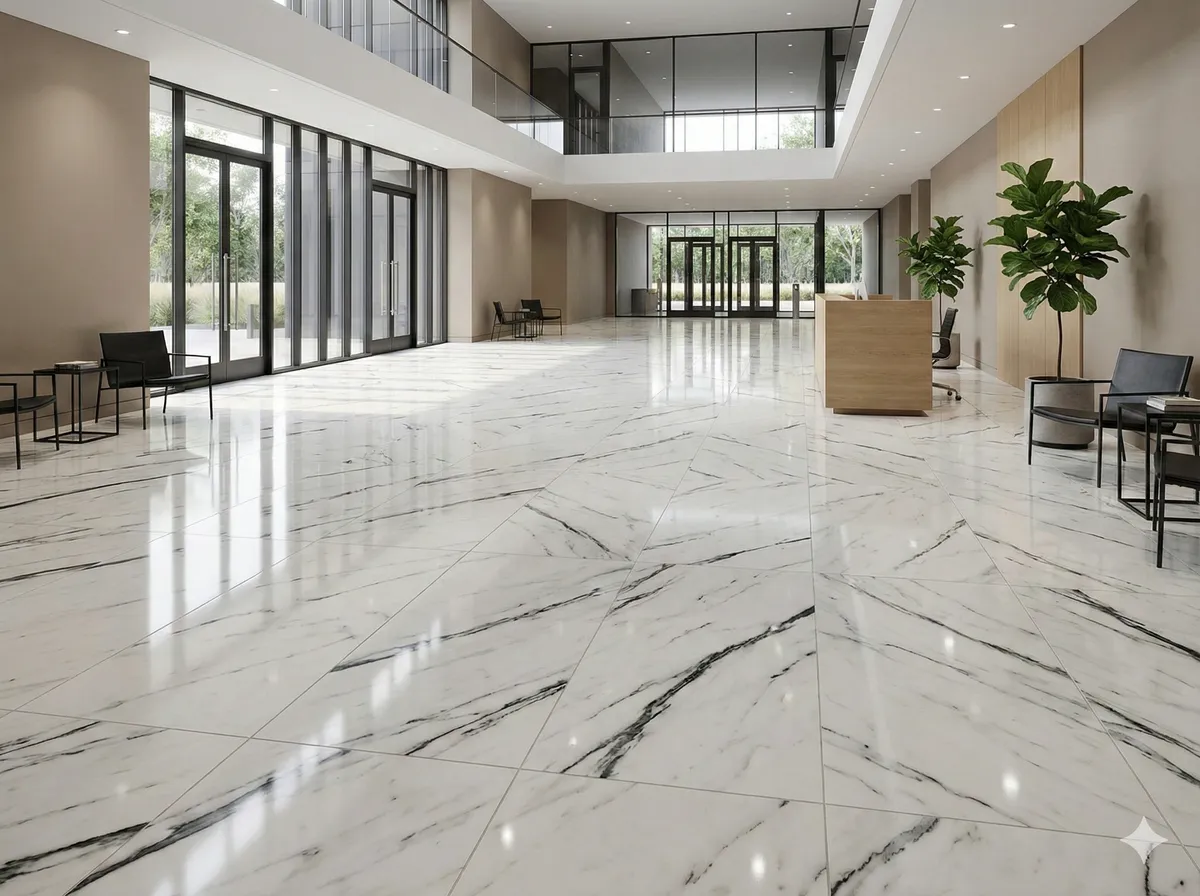
The lobby is the first impression. It needs to handle rolling luggage, wet shoes, and heavy foot traffic while still looking sharp. We usually recommend porcelain tile for high-end lobbies or commercial LVT (20mil+ wear layer) for a warmer wood or stone look at a lower installed cost. Both clean easily and resist water tracked in from outside.
- •Avoid: carpet in entry zones — it traps moisture, stains quickly, and wears unevenly at doorways.
Corridors and Elevator Landings
Corridors take concentrated linear traffic. The same narrow path gets walked thousands of times a day. Carpet tile in a heavy-duty specification works well here — individual tiles can be swapped out when worn, keeping the corridor looking consistent without a full replacement. Commercial LVT is also a strong choice for corridors that see cart or dolly traffic.
- •Avoid: broadloom carpet — it can't be spot-replaced and shows wear patterns in high-traffic lanes.
Open Office Areas
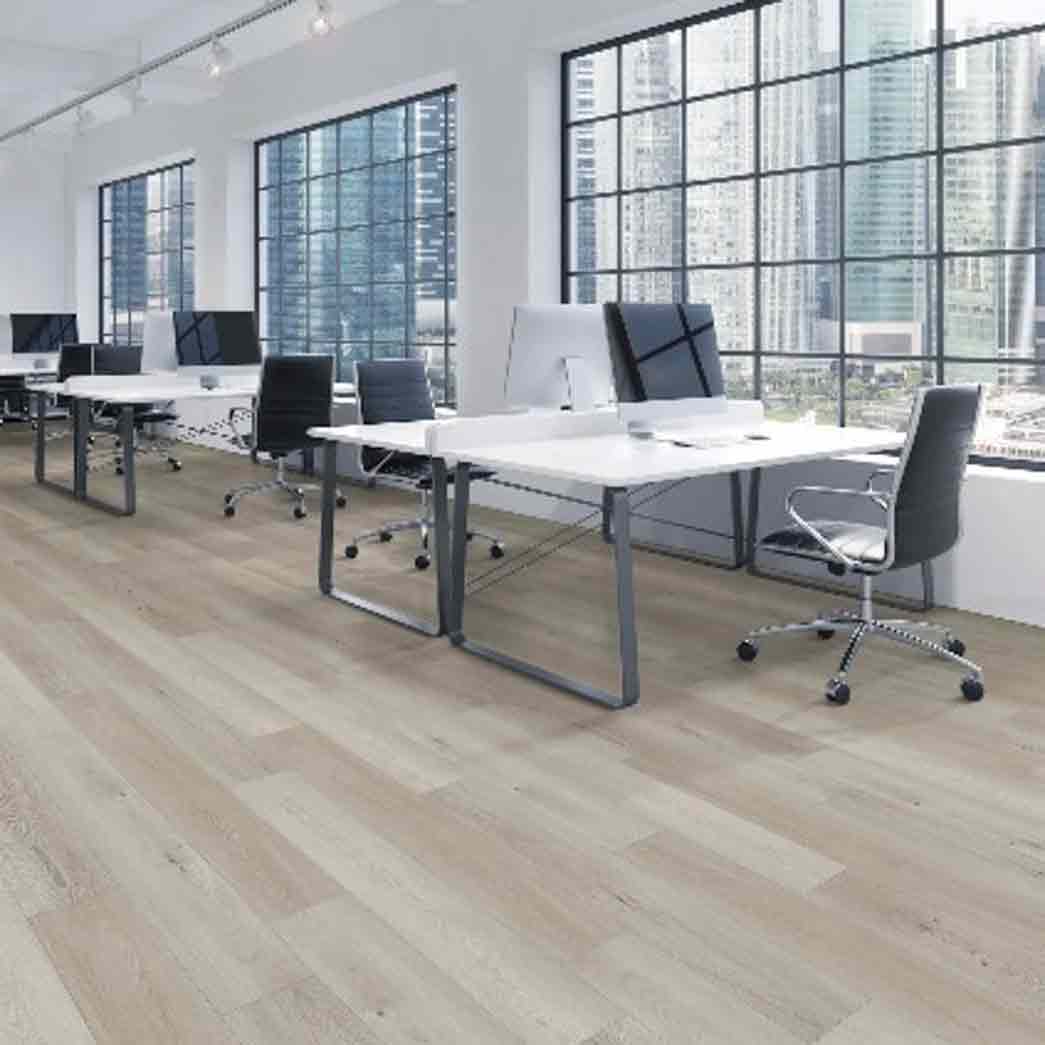
Open offices need acoustic performance to control noise and a surface that holds up under rolling task chairs. Carpet tile is the default here — it dampens sound, hides minor stains, and allows modular replacement. For offices going with a hard-surface look, a thick commercial LVT with an acoustic backing can work, but chair mats may be necessary.
- •Avoid: thin glue-down LVT without acoustic underlayment — it amplifies footstep noise in open layouts.
Conference Rooms
Conference rooms need a polished look and acoustic privacy. Carpet tile handles both — it reduces echo during calls and presentations and provides a professional appearance. Premium LVT planks can also work in executive conference rooms where a hardwood aesthetic is preferred.
- •Avoid: polished hard surfaces without acoustic treatment — they create echo that makes conference calls difficult.
Break Rooms and Kitchenettes
Spills are constant in break rooms. The flooring needs to resist staining, clean up fast, and handle chair movement. LVT/LVP is our go-to recommendation — it's waterproof, stain-resistant, and doesn't require the waxing that VCT demands. Sheet vinyl is another solid option for smaller kitchenettes since it has no seams for liquids to penetrate.
- •Avoid: carpet of any kind — food and beverage spills lead to permanent staining and odor.
Restrooms
Restroom flooring must be waterproof, slip-resistant, and easy to sanitize. Porcelain tile with a textured finish is the standard for a reason — it handles water, cleaning chemicals, and heavy use without deteriorating. Sheet vinyl with heat-welded seams is a budget-friendly alternative that also prevents water penetration.
- •Avoid: any product with seams that aren't sealed — water migrating under the flooring causes mold and adhesive failure.
Spec Checklist Before You Bid
If you're a building owner, property manager, or GC putting together a flooring scope for an office building, make sure these items are addressed before you go out for bids. Gaps here lead to change orders and delays.
- • Moisture testing: Calcium chloride and/or in-situ relative humidity testing on concrete slabs, especially at grade or below grade. Results dictate adhesive selection and whether moisture mitigation is needed.
- • Subfloor flatness: Specify FF/FL tolerances. Most resilient flooring manufacturers require 3/16" in 10' or better. Budget for concrete prep and leveling if the slab doesn't meet spec.
- • Transitions: Define every flooring-to-flooring transition, especially at elevator lobbies, suite entries, and restroom thresholds. Specify transition strip style, material, and color.
- • Wall base: Specify type (rubber, vinyl, wood), height (typically 4" or 6"), and color. This is frequently left out of bids and creates confusion at installation.
- • Slip resistance: Verify that specified products meet slip resistance requirements for each zone, particularly lobbies and restrooms where wet conditions are expected.
- • Rolling load rating: In open offices with task chairs and in corridors with delivery carts, confirm the flooring's rolling load specification matches the actual use.
- • Cleaning chemical compatibility: Confirm that the building's janitorial products are compatible with the specified flooring. Some commercial cleaners damage certain finishes or void manufacturer warranties.
Downtime and Phasing Plan
Most office flooring projects happen in occupied buildings, which means the installation has to work around the tenants — not the other way around. We typically run after-hours and weekend crews to keep the building fully operational during business hours. The space is cleaned and ready for occupancy each morning.
For larger projects, we phase the work by floor or wing. Furniture is moved in stages, work areas are sealed off with dust barriers, and HVAC returns are covered to prevent debris from circulating through the building. If the project involves demolition of existing flooring, we schedule the noisiest work — tile chipping, adhesive grinding — during off-hours and contain the dust with negative air machines.
Access planning matters just as much as the install schedule. We coordinate freight elevator access, loading dock timing, material staging areas, and dumpster placement before the project starts. When multiple contractors are working in the same building, we align our schedule with theirs to avoid conflicts.
Maintenance Reality Check
The maintenance program you commit to at installation determines how long the flooring actually lasts. Here's what each system realistically requires in a typical office environment.
- • Carpet tile: Vacuum daily in high-traffic areas. Spot clean spills immediately. Schedule hot water extraction every 12-18 months. Keep spare tiles from the original dye lot for replacements.
- • LVT/LVP: Dust mop or auto-scrub daily. Damp mop with manufacturer-approved cleaner weekly. No waxing or polishing needed. Recoat the factory finish every few years in extremely high-traffic lobbies.
- • Porcelain tile: Sweep and mop regularly. Regrout and reseal grout lines periodically, especially in restrooms. Tile itself is nearly maintenance-free — the grout is where problems appear.
- • Sheet vinyl: Auto-scrub or damp mop regularly. Avoid harsh abrasives. Heat-welded seams should be inspected annually in wet areas.
The key takeaway: every flooring system requires some maintenance. The question is whether that maintenance fits your building's janitorial program. If your cleaning crew doesn't have an auto-scrubber, don't specify a floor that needs daily scrubbing.
Cost Drivers
Office building flooring costs vary significantly depending on factors that have nothing to do with the material itself. Here's what actually drives the final number.
- • After-hours labor: Evening and weekend installation crews command a premium over standard daytime work. The more the schedule is constrained, the higher the labor cost.
- • Subfloor condition: Older buildings often have uneven or damaged slabs. Skim coating, grinding, and self-leveling compound add cost but are non-negotiable for a proper installation.
- • Moisture mitigation: If slab moisture exceeds manufacturer limits, an epoxy moisture barrier or topical mitigation system is required before any flooring goes down.
- • Existing flooring removal: Removing old carpet, VCT, or tile — especially when old adhesives contain asbestos or require abatement — is a significant line item.
- • Furniture moving: If the installer is responsible for moving desks, file cabinets, and workstations, this adds labor and time. Some buildings handle this separately.
- • Phasing complexity: A single-floor, vacant install is straightforward. A 10-floor occupied building done one wing at a time over several months requires project management overhead that adds real cost.
- • Number of transitions and details: Complex floor plans with lots of doorways, mixed materials, and tight areas take more time to cut, fit, and finish than wide-open rectangular spaces.
FAQs
Can flooring be installed in an occupied office without shutting down?
Yes. We do this regularly. The work is phased by zone and scheduled during after-hours or weekends. Each section is completed and cleaned before employees arrive in the morning. Dust containment and noise control are part of the standard scope.
What's the best flooring for office areas with rolling chairs?
Carpet tile is the most common choice — it handles caster traffic well and provides acoustic benefits. If you want a hard surface, specify a commercial-grade LVT with a 20mil or thicker wear layer and confirm its rolling load rating.
How long does a full-floor office installation take?
It depends on the scope, but a typical single floor of a mid-size office building — with furniture moving, demo, prep, and installation — usually runs one to three weeks when done after hours. Larger or more complex floors take longer. We provide a detailed phasing schedule during the proposal process.
Should we replace all the flooring at once or do it in phases?
Phasing is usually the practical choice in occupied buildings. It spreads the disruption and the cost. The trade-off is that phased projects take longer to complete overall and require careful planning around transitions between new and existing flooring.
Do we need to test for moisture before installing new flooring?
On concrete slabs, yes — always. Moisture testing is non-negotiable. Elevated moisture ruins adhesives and causes flooring failure. We test every slab and recommend mitigation when results exceed manufacturer limits.
How do we choose between LVT and carpet tile for an office?
It comes down to acoustics, aesthetics, and maintenance. Carpet tile is quieter and hides wear better in open office layouts. LVT is easier to clean and works better in zones with spills or moisture. Many office buildings use both — carpet tile in workspace areas and LVT in lobbies, break rooms, and corridors. Our LVT vs. carpet tile comparison breaks this down in detail.
Related
Resources
- • LVT vs. Carpet Tile for Offices
- • Planning a Flooring Replacement in an Occupied Building
- • Subfloor Prep 101
Flooring Types
Services
Case Studies
Ready to Update Your Office Flooring?
Contact us for a free site walk and detailed proposal for your office building project.
Request a Quote